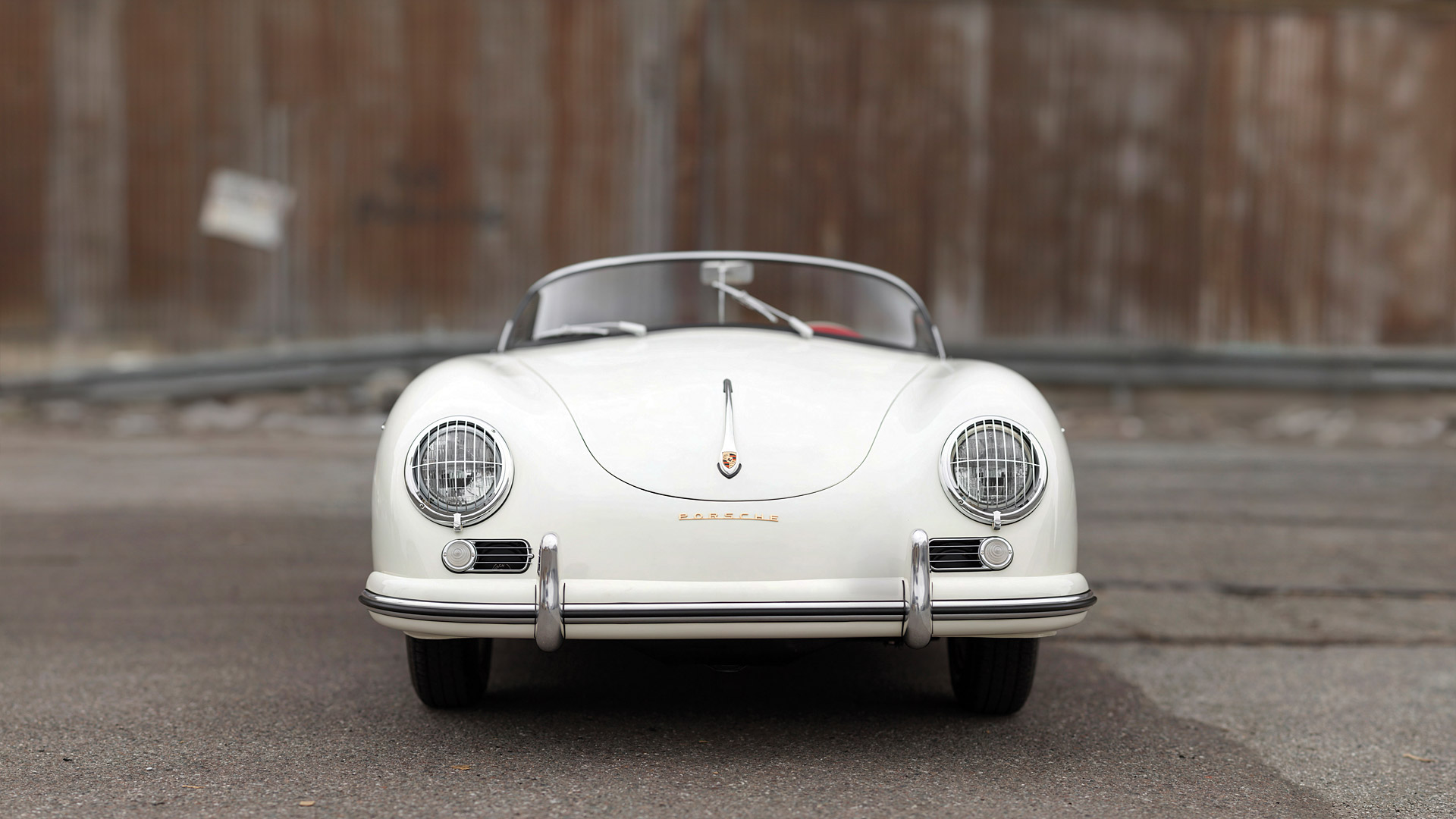
The 356 was built in four distinct series, the original (“pre-A”), followed by the 356 A, 356 B, and finally the 356 C. To distinguish among the major revisions of the model, 356s are generally classified into a few major groups. The 356 coupés and “cabriolets” (soft-tops) built through 1955 are readily identifiable by their split (1948 to 1952) or bent (centre-creased, 1953 to 1955) windscreens. In late 1955 the 356 A appeared, with a curved windshield. The A was the first road going Porsche to offer the Carrera four-cam engine as an option. In late 1959 the T5 356 B appeared; followed by the redesigned T6 series 356 B in 1962. The final version was the 356 C, little changed from the late T6 B cars but disc brakes replaced the drums.
In late 1955, with numerous small but significant changes, the 356 A was introduced. Its internal factory designation, “Type 1”, gave rise to its nickname “T1” among enthusiasts. In the US 1,200 early 356s had been badged as the “Continental” and then a further 156 from autumn 1955 to January 1956 as an even rarer T1 “European” variant after which it reverted to its numerical 356 designation. In early 1957 a second revision of the 356 A was produced, known as Type 2 (or T2). Production of the Speedster peaked at 1,171 cars in 1957 and then started to decline. The four-cam “Carrera” engine, initially available only in the spyder race cars, became an available option starting with the 356 A.